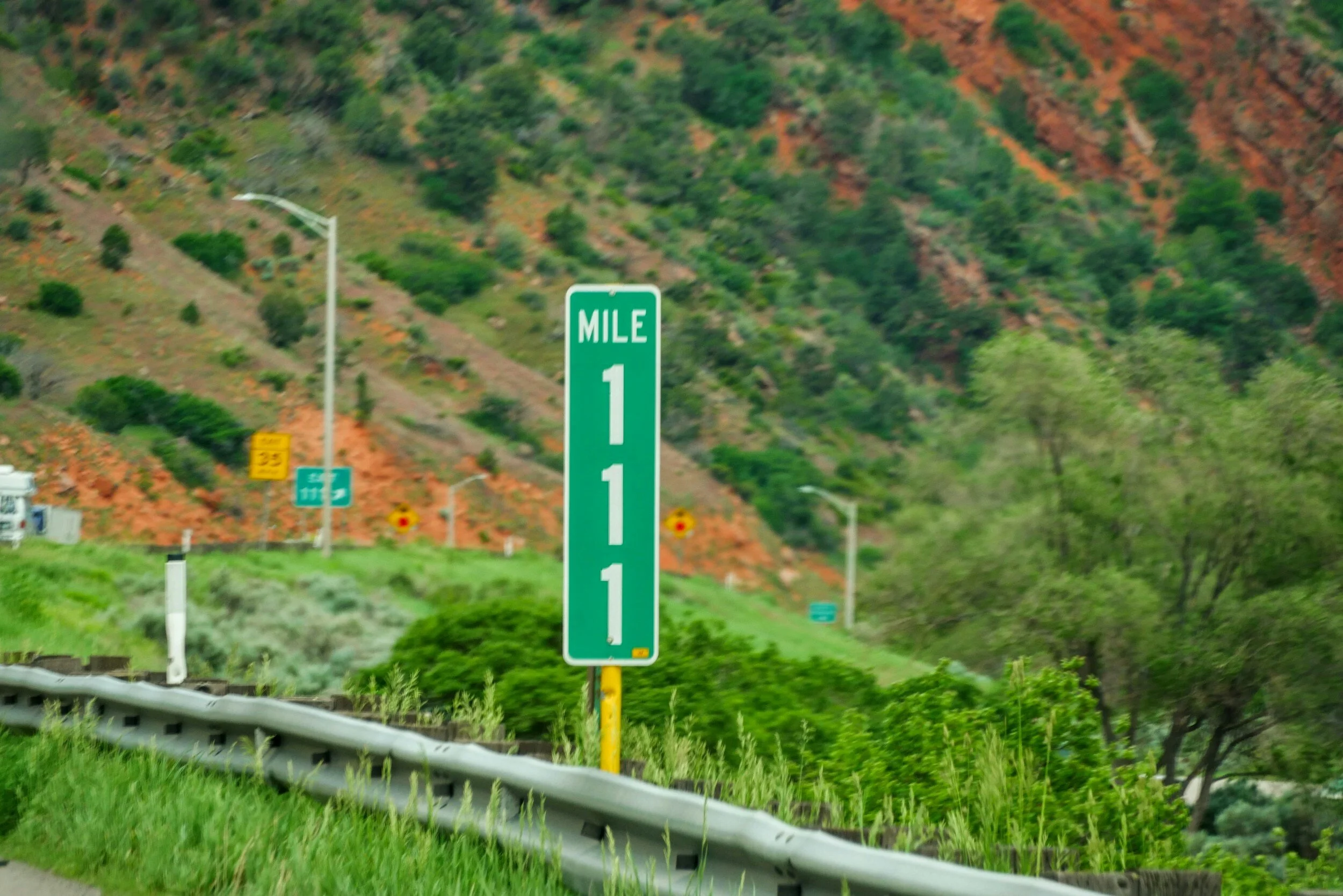
Credit: Unsplash
We see them when we’re driving down the highway. We have to remember which one we just passed if we’re calling 911 to report an emergency so we know where to send help.
Mile markers are hidden in plain sight and serve only a momentary purpose if we even notice them or think about them at all.
But did you know there’s a lot more to the mile marker than meets the eye? It’s not just a tiny green sign on the side of the road that keeps us on track. It's a simple object that points us forward but whose story leads us back millenia. There may even be as many fun facts about mile markers as there are actual mile markers in the United States.
How Long is a Mile?
Let’s first define the mile before we talk about why mile markers exist. The word "mile” comes from “milia passuum”, which translates from Latin to one thousand paces, according to the Lower Merion Historical Society in Pennsylvania. We know the mile to be 5,280 feet. You can remember that distance based on a little memory story from one of the dads in my cub scout troop, Mr. Replogle: there once was a prisoner. His number was 52. He was so depressed about being in prison that he didn’t eat anything. So 52 ate nothing. 52 8 0, 5,280.
Measuring the Mile
You can probably imagine that counting steps to measure distance probably was not economical or very fun to keep up with on a long journey. The United States National Park Service says a Roman engineer and city planner invented the first device to measure distance besides just counting steps. Vitruvius was his name and he is said to have invented the first odometer around the first century BC. His invention almost looked like a water wheel on a smaller scale that was designed for measuring land distance. Basically, NPS says this thing would deposit a small rock in a container after one turn traveling across the ground and after so many of those rocks were deposited, you would know how far you traveled.
Both NPS and Lower Merion Historical society say Ben Franklin adapted a version of the odometer and put them on mail carts to keep postal carriers on track and on time and to improve mail routes in Philadelphia and surrounding areas. This is also how mile markers became popular along major roads, according to several sources, because postal carriers needed a way to stay on track and on time.
Where Did the Mile Marker Come From?
The Lower Merion Historical Society says the earliest form of mile markers were first used in ancient Rome and marked the distance from The Forum in the center of Rome. This was the center of Roman civilization, so having a way to track distances that led to and from The Forum helped Roman citizens find their way.
From what my research tells me, there’s not one formal date when mile markers were all of a sudden everywhere in the United States. The signs seemed to start over time out of a seeming abundance of practicality. There were stone markers along major routes according to the Lower Merion Historical Society that would assist folks traveling. Many of these markers that have been preserved can still be seen, especially in the Northeastern United States, today.
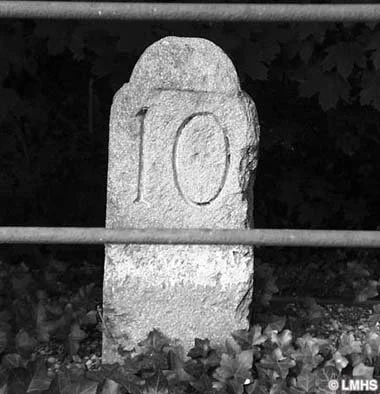
Credit: Lower Merion Historical Society
The closest I found to a formal date when mile markers were officially used came in a conversation with the National Park Service. They say the National Road was the first federally funded highway and that’s where we saw mile markers first appear formally in the United States 1830s. Ranger and Historian Brian Reedy helped me understand this by walking me through a fascinating rundown of the National Road. He says Congress authorized its construction in 1806. Construction started in 1811 in Cumberland, Maryland and was completed by 1818. More states were added along the route after that, taking the national road all the way to Southern/Central Illinois. Reedy went on to say that by 1830, the federal government turned control and financial responsibility to the states it ran through who then put up more formal cast iron mile markers. The National Road became formally known as US 40 in the 1920s.
The Fort Necessity National Battlefield in Farmington, Pennsylvania is located just off US 40 and offers some great resources on the national road both online and in person.
How Do You Read Mile Markers?
Here's how to read mile markers according to the United States Department of Transportation: the green signs along interstates marking miles always start at the southernmost and westernmost points. So USDOT says if you’re on I-95 in Pennsylvania traveling north, the mile 1 sign is located 1 mile from inside the state line and that number gets larger the further north you go. If you’re coming in from the west on I-80, the number gets larger the further east you go, while starting 1 mile from the western border.
If you're like me and wondering “well, what about when a highway starts in a state?” The Department of Transportation has an answer for you there as well! The numbering begins at the beginning junction of the road.
Here’s another fun fact in case you didn’t know: you can tell the primary direction of interstates by the final number in the interstate number. Even numbers are east/west, odd numbers are north/south. So I-45 in Texas is a north/south route while I-10 is an east/west route.
Conclusion
The little green signs that help us along our way have been around for roughly six thousand years in one form or another and are the result of practical thinking developed over time. Where ancient societies used rocks and stones, we now use metal signs.
Make sure to check out our episodes for your next trailhead to knowledge!
Sources and Further Reading:
Britannica, T. Editors of Encyclopaedia (2024, March 18). Vitruvius. Encyclopedia Britannica. https://www.britannica.com/biography/Vitruvius
Francis, Gerald A. (2024, March 19). The Milestones. The Lower Merion Historical Society. https://lowermerionhistory.org/home/full-text/contents/milestones/#:~:text=Ancient%20Landmarks,go%20to%20reach%20their%20destination
History.com Editors. (2024, March 19). Roman Forum. A&E Television Networks. https://www.history.com/topics/ancient-rome/roman-forum#
Marsteller, Duane and Tracy. (2024, March 2019). Mile Markers. The Historical Marker Database. https://www.hmdb.org/m.asp?m=175105
United States National Park Service. (2024, March 19). Mormon Odometer. https://www.nps.gov/articles/000/mormon-odometer.htm#:~:text=In%201628%2C%20Thomas%20Savery%20invented,the%20mileage%20of%20the%20routes
United States National Park Service. (2024, March 19). The National Road. https://www.nps.gov/articles/national-road.htm
Phone Interview with National Park Ranger and Historian Brian Reedy, 2023